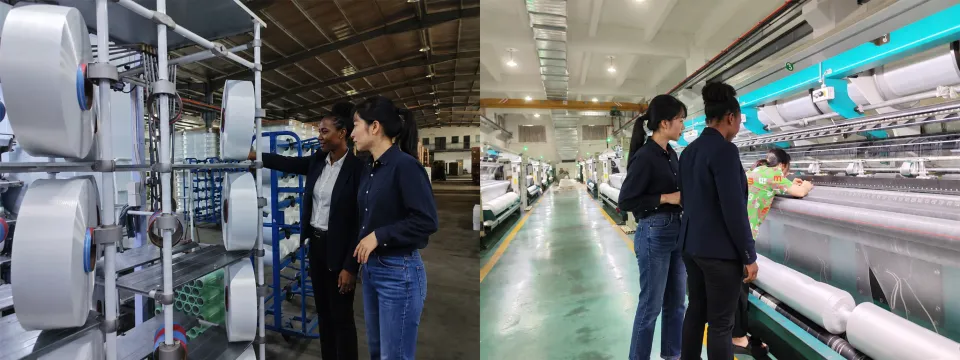
A warp knitting factory check before bulk orders helps prevent costly quality disputes. Finished swatches and public certifications are not enough to prove repeatable production control.
The audit should inspect yarn preparation, machine setup, in-line defect monitoring, and final AQL 2.5 inspection. For warp-knitted tricot and raschel fabrics, bulk quality is set at the warping creel and knitting needle bed before dyeing begins.
A common quality gap appears when the approved lab dip and sample look correct, but the production rolls arrive with shade variations, structural streaks, or hidden needle holes. Once the fabric is cut, the garment factory may reject the batch, leading to delay and dispute.
Warping Yarn Preparation: The Foundation of Knitted Quality
The warp-knitting process begins at the warping creel. Unlike weft knitting, warp knitting winds thousands of parallel yarns onto a sectional warp beam before the yarns reach the needles.
For broader structure context, Textile World's knit structures overview explains how warp knitting differs from weft knitting by yarn path and machine formation. A factory audit should therefore focus on beam preparation, guide-bar control and needle-bed condition, not only finished-roll appearance.
The critical variable is yarn tension consistency. Tight yarn ends knit smaller loops, while loose yarn ends knit larger loops. After dyeing, those loop differences can appear as barre or horizontal streaks across the fabric width.
- Room condition: keep temperature at 22±2°C and relative humidity at 60% to 65% RH.
- Fiber reason: nylon is moisture-sensitive, so humidity shifts can change friction and yarn tension.
- Control point: electronic creel tensioners should keep variation within ± 1.0 cN across yarn ends.
Warp Knitting Factory Audit Checklist: Process Control Points
The table below provides a technical process-control checklist for auditing warp-knitting operations during a factory visit.
| Factory Department | Key Process Parameter | Control Standard / Limit | Defect Risk Controlled | Inspection Standard |
|---|---|---|---|---|
| Yarn Creel & Warping | Creel room humidity and yarn winding tension | 60% - 65% RH; Winding tension ± 1.0 cN | Yarn tension variation, barre streaks, stripe defects | Electronic tension log check |
| Knitting Room | Karl Mayer machine needle wear and laser scanner | Daily needle wear check; 100% active laser sensor | Drop stitches, needle lines, yarn breakage holes | Machine maintenance log review |
| Greige fabric inspection | Visual check on back-lit inspection frame | 100% greige rolls inspected and flagged | Greige defects expanding during dyeing and stenter | ISO 9001 internal auditing |
| Dyehouse & Finishing | Stenter overfeed and thermoset temperature | Nylon: 170°C, Polyester: 180°C; Overfeed ± 2% | Uncontrolled shrinkage, width loss, harsh handfeel | ISO 6330 shrinkage test |
| Final Roll Inspection | Visual grading under four-point system | Max. 20-28 points per 100 sq. yards (A-Grade) | Shipped fabric defects, cutting room yield loss | ASTM D5430 Four-Point |
Knitting Machine Setup: Karl Mayer Compound Needles Inspection
Modern high-speed warp knitting machines, such as Karl Mayer HKS tricot lines, run compound sliding needles at speeds exceeding 2,000 RPM. The knitting room therefore needs close inspection to confirm that the machinery is being maintained correctly. Compound needles feature a tiny slide wire that closes the needle hook. If a needle hook is worn or bent, it will snag the filament yarn, creating continuous vertical lines along the fabric length—known as "needle lines." If a needle breaks completely, it causes "drop stitches," resulting in holes that expand during dyeing and finishing.
Automated in-line defect detection prevents small knitting faults from becoming bulk-roll failures. Quality teams should confirm that machines have active laser scanners or camera inspection systems mounted across the needle beds.
- Trigger: when yarn breaks or a needle hook fails, the sensor detects a loop gap.
- Machine response: the system should stop the frame within fractions of a second.
- Audit proof: review weekly sensor calibration logs and lot-start needle bed inspection records.
In-Line Defect Monitoring and AQL 2.5 Final Inspection
Once the fabric is knit, the greige rolls are run through a greige inspection frame. Checking fabric at this stage is critical because dyeing and stenter tension will expand small holes and tension marks. The factory's quality team must flag and record defects on a roll mapping sheet. After dyeing and stenter heat-setting, the finished fabric rolls must undergo a final visual inspection on a sloped, back-lit inspection table. High-quality mills grade finished fabric under the ASTM D5430 standard test methods for visually inspecting and grading fabrics (Four-Point System).
Under ASTM D5430, points are assigned by defect length: 1 point up to 3 inches, 2 points from 3 to 6 inches, 3 points from 6 to 9 inches, and 4 points above 9 inches.
For premium activewear and intimate apparel, the acceptance limit is often 20 to 28 points per 100 square yards. Rolls above the agreed limit should be downgraded to B-grade and excluded from shipment.
- Final sampling: verify AQL 2.5 inspection based on ISO 2859-1 before packing.
- GRS orders: match Transaction Certificates with final roll weights.
- Chain of custody: compare TC records, warping inputs, knitting logs, and shipping documents.
FAQ: 3 critical questions teams ask the mill
Q1. How does a warp knitting factory prevent barre defects in dyed nylon spandex fabrics?
Preventing barre requires three control gates. First, the mill must separate yarn lots and never mix different raw material batches within the same warping beam. Second, the warping creel room must maintain temperature and humidity controls to ensure uniform moisture regain and yarn friction. Third, the mill must utilize electronic tensioners to feed yarn at a consistent tension. At Changle Textile, we log the tension profile of every beam to guarantee barre-free bulk fabrics.
Q2. What is the significance of the "run-in" length log recorded on Karl Mayer machines?
The "run-in per rack" refers to the length of yarn in millimeters fed from each warp beam to knit 480 courses of fabric (one rack). This parameter determines the loop length and stitch density. If the run-in length varies between machines or production shifts, the finished fabric weight (GSM) and stretch recovery will vary across rolls. The machine's electronic run-in log should remain within ± 2% of the approved sample setup.
Q3. How should a mill's GRS recycled certification be verified during a remote audit?
A remote audit should focus on two documents. First, check the mill's Scope Certificate (SC) to verify that they are authorized to process recycled materials. Second, request the Transaction Certificates (TCs) for the specific yarn batches used in your order. The TCs must show the certified yarn weights, matching the input weight of the warping and knitting records, and the final shipping documents, proving the material's origin.
Q4. What should be fixed before a warp-knitting factory audit?
Before a warp-knitting factory audit, the audit requirements should already define the target warp-knit structure, the key production risks and the required inspection records.
For more details on fabric grading, refer to the ASTM D5430 guidelines. For quality management system requirements, consult the ISO 9001 standards, and for laundering procedures, review the ISO 6330 specifications.
Changle Textile operates advanced Karl Mayer warp-knitting lines under strict ISO 9001 quality controls, providing GRS-certified meshes and tricot fabrics for technical apparel programs. Teams can review our factory background on our about us page or inspect our available certificates and compliance records. To discuss your quality specifications or start a development, please contact us through our fabric inquiry form.
Continue your fabric sourcing review
Compare the related category and product examples, then send your target composition, GSM, width, end use, quantity or sample reference for a factory review.