
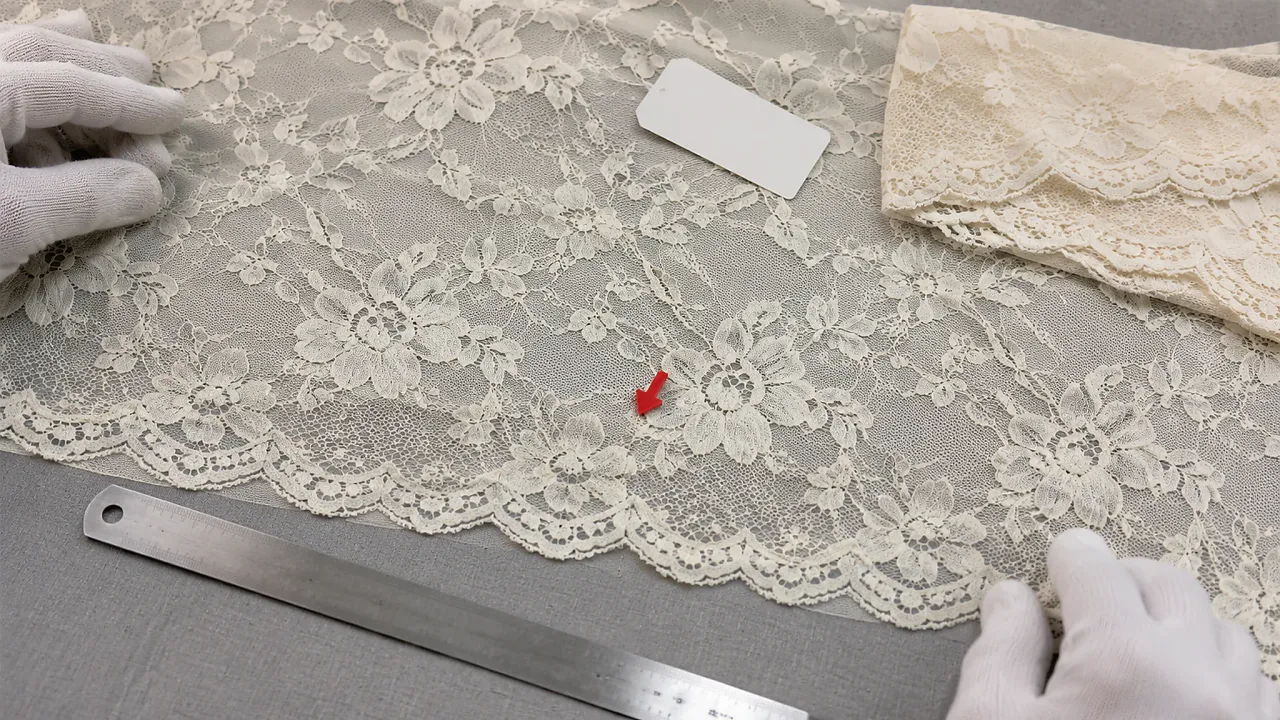
When incoming lace differs materially from the approved reference, hold the affected rolls before cutting. Identify the batch, roll and location of the observation; compare it under the agreed conditions; and record enough evidence for the sourcing, quality and fabric-supplier teams to make the same decision. Cutting first and investigating later removes the option to isolate the fabric cleanly.
A visible difference is not automatically a rejectable defect. Lace is an open, patterned textile, and the acceptance decision depends on the approved sample, order specification, intended garment panel and agreed test conditions. This guide provides an inspection workflow, not a universal defect allowance or pass-fail standard.
Start with the approved lace reference and incoming-roll identity
Incoming inspection is only repeatable when the team knows what the bulk fabric is being compared with. Keep the sealed or controlled approval sample, approved colour reference and final specification available at the inspection table. Do not compare a production roll with an unlabelled development swatch, a phone image or a sample from another colour lot.
| Inspection reference | What to confirm | Why it matters |
|---|---|---|
| Purchase order and specification | Article, colour, format, quantity and agreed requirements | Prevents the wrong programme or unfinished field from becoming the comparison basis |
| Approved physical sample | Approval version, date, face, direction and usable edges | Connects appearance and behaviour to a controlled reference |
| Incoming-roll label | Batch, roll number, colour lot and received quantity | Allows an observation to be traced and isolated |
| Garment and panel role | Cup overlay, body panel, wing, trim, neckline or other placement | The same variation can have different consequences in different panels |
| Inspection conditions | Lighting, relaxed or extended state, measuring direction and method | Makes later checks and supplier review comparable |
Prepare the lace for a comparable incoming inspection
Open enough fabric to observe the full usable width without pulling the selvage, scallop or decorative edge straight. If the order or test method defines conditioning or relaxation, follow that requirement before taking dimensions. Where no duration has been agreed, record the actual rest condition instead of presenting an improvised time as an industry rule.
- Check that the roll label and colour lot match the receiving documents.
- Lay the fabric without stretching, pinning or forcing a wavy edge flat.
- Identify the face, fabric direction, decorative edge and usable-width boundaries.
- Use the agreed light source for colour decisions and record the source used.
- Keep the approved sample beside the incoming material, not in a separate room or image file.
- Mark the roll position of each observation before cutting a specimen from the roll.
Separate an inspection observation from an agreed defect
Inspectors should describe what they can see or measure before assigning a cause or disposition. For example, record that a motif is interrupted across a defined area rather than immediately stating that a knitting setting failed. The supplier can then investigate the production cause while the garment factory decides whether the observed area affects cutting, placement or finished appearance.
| Record first | Decide second | Avoid assuming |
|---|---|---|
| What is different from the reference | Whether the difference affects the intended panel | That every visible variation has the same severity |
| Where it occurs on the roll and across the width | Whether affected material can be isolated | That one photographed area represents the complete shipment |
| The inspection and measurement conditions | Whether another check or supplier review is needed | That measurements taken under different conditions are comparable |
Inspect lace-specific structural and surface defects
Review the lace at full width and at close range. A decorative opening that belongs to the approved motif is not a hole defect; an unintended break, missing connection or enlarged opening must be compared with the reference. Record the size, direction, frequency and location of the observation instead of relying on a close-up image without scale.
| Observation group | What the garment factory checks | What to record |
|---|---|---|
| Broken or missing yarn | Interrupted connections, loose ends or missing portions of the motif | Length, width, roll position and whether the area grows under handling |
| Unintended opening or ladder | An opening that differs from the approved repeat or extends along a yarn direction | Scaled overview, close-up and affected direction |
| Motif interruption | Missing, doubled or visibly displaced decorative elements | Repeat position and comparison with the approved motif |
| Join, repair or local change | A local construction or appearance change that may interrupt marker placement | Beginning and end position plus the length that may need isolation |
| Stain, contamination or handling damage | Marks, oil, dirt, crushing, snagging or packaging damage | Surface area, penetration, roll layer and packaging condition |
Measure motif repeat, scallop alignment and usable width
A roll can appear visually attractive and still create a cutting problem when repeat spacing, usable width or decorative edges differ from the approved sample. Measure in the same fabric direction and state used for approval. For paired panels or edge placement, compare left-right alignment and the usable area available after excluding any non-usable edge.
| Geometry check | Customer-factory question | Production consequence to review |
|---|---|---|
| Motif repeat | Does the repeat match the approved direction and scale? | Marker placement, matching and visual balance |
| Scallop depth and spacing | Can paired or continuous edges be cut as planned? | Neckline, hem, cup or trim alignment |
| Usable width | How much width remains after non-usable edges are excluded? | Consumption, marker yield and panel availability |
| Edge waviness | Does the edge lie as approved after the agreed relaxation? | Cutting accuracy, feeding and finished-edge appearance |
| Appearance under extension | Does the motif remain acceptable at the agreed extended state? | Coverage, transparency and motif distortion in wear |
Check shade and finish by lot, roll and lace area
Compare colour with the approved physical reference under the agreed light source. Review the ground, dense motif and decorative edge because different lace areas can present colour and sheen differently. Keep the complete colour-development procedure in the lab dip, strike-off and bulk shade guide rather than duplicating it in the incoming-inspection record.
- Compare the incoming lot with the approved physical colour standard.
- Check roll-to-roll differences before mixing rolls in one garment or colour set.
- Review dense motifs, open grounds and scalloped edges separately when their appearance differs.
- Record the light source, sample orientation and any backing used during assessment.
- Keep colour, gloss, handfeel and surface-finish observations as separate report fields.
ISO 105-A02:1993 describes the grey scale used to assess change in colour in colour-fastness tests. It is a grading reference for the applicable test result, not a replacement for the order's approved shade, viewing conditions or pass-fail requirement.
Compare stretch lace in relaxed and agreed extended states
A hand-pull check can reveal an obvious difference, but it does not establish elongation, recovery or holding force. Use it only as a screening observation. When the order includes measured elastic behaviour, compare the correct specimen format, direction, conditioning and test cycle stated in the agreed method.
ISO 20932-1:2018 describes strip-test methods for fabric elasticity and excludes narrow fabrics. ISO 20932-3:2018 covers elasticity and related properties of narrow fabrics. A full-width lace and a narrow lace trim therefore should not be treated as interchangeable specimens when the programme relies on these methods.
| Stretch observation | What to compare | When to hold for technical review |
|---|---|---|
| Direction | Length, width and any approved bias or multi-directional behaviour | The incoming roll behaves differently from the approved direction |
| Motif under extension | Shape, opening size, coverage and visual balance at the agreed state | The intended garment panel loses required appearance or coverage |
| Recovery | Return behaviour under the agreed method and timing | A measured result or visible residual deformation falls outside the order requirement |
| Edge response | Curl, wave or asymmetry after the agreed handling | The edge cannot be placed or sewn according to the approved construction |
Run a small cutting and sewing trial before bulk release
Visual roll inspection does not show every interaction with the garment construction. Cut a controlled trial from representative material and use the intended lining, elastic, stitch direction and handling method. The goal is not to redesign the garment during incoming inspection; it is to confirm that the approved combination still cuts, feeds and returns as expected.
- Confirm that the marker can place motifs and scallops in the intended locations.
- Check whether the edge shifts, waves or curls during spreading and cutting.
- Sew the lace with the planned lining, elastic, thread and seam direction.
- Compare the finished trial with the approved garment or sample construction.
- Keep the trial and its roll identity with the inspection decision.
The trial criteria should follow the lace type and panel job. Use the stretch lace versus rigid lace specification guide when the team still needs to define which behaviours belong in the approval package.
Know when visual inspection needs an agreed laboratory test
Incoming inspection can identify visible or measurable differences, but it cannot replace a required laboratory method. The buyer, garment factory, laboratory and fabric supplier should work from the same method, specimen direction, preparation, cycle and reporting rule. A standard number without those conditions is not a complete acceptance specification.
| Approval question | Relevant reference | Boundary |
|---|---|---|
| Does the textile change dimension after specified washing and drying? | ISO 5077:2007 | Use the specified washing and drying combination; do not transfer a result from another procedure |
| How does full-width fabric extend and recover? | ISO 20932-1:2018 | Confirm specimen direction, conditioning, extension and reporting conditions |
| How does a narrow lace or elastic trim extend and recover? | ISO 20932-3:2018 | Do not substitute a full-width strip method without technical agreement |
| How is colour change graded after an agreed colour-fastness test? | ISO 105-A02:1993 | The grey scale grades change; the programme still needs the applicable fastness method and limit |
ASTM D5430-26 provides standard test methods for visually inspecting and grading fabrics. If a contract uses a visual grading system, record the chosen option and acceptance rule in the order documents. Do not assume that the standard's existence creates one universal lace allowance for every garment factory.
Use a disposition matrix before releasing lace to cutting
| Disposition | Use when | Required record |
|---|---|---|
| Release | The inspected material meets the agreed reference and requirements | Rolls checked, date, inspector and approval basis |
| Segregate | A traceable roll, lot or section needs separate use or review | Physical identification and quantity held apart |
| Expand inspection | The first sample does not show whether the observation is isolated or recurring | Expanded scope, locations checked and updated findings |
| Hold for technical decision | The effect on cutting, sewing, appearance or performance is unresolved | Decision owner, required trial or test and deadline |
| Supplier review | The incoming material differs from the approved reference or order requirement | Traceable defect report, retained sample and requested response |
The matrix organizes action; it does not replace the commercial agreement. Rework, concession, replacement, return or alternate use requires approval from the responsible buyer and supplier roles. Keep held material physically identified so it cannot re-enter cutting through an undocumented handoff.
Send the fabric supplier a traceable lace defect report
A message saying that the lace is bad does not show which material was checked or how the comparison was made. A useful report lets the garment factory, brand and fabric supplier review the same evidence without guessing which roll, state or section appears in a photograph.
- Purchase order, fabric article, colour and received date.
- Batch, colour lot and roll number.
- Meter or yard position and location across the width.
- Observed difference stated without an unverified production cause.
- Scaled overview and close-up photographs using the same orientation.
- Approved sample or specification field used for comparison.
- Lighting, relaxation, extension and measurement conditions.
- Quantity checked, affected and held.
- Effect observed in cutting, trial sewing or the intended panel.
- Requested next action and the date by which a decision is needed.
| Report field | Example format |
|---|---|
| Identity | PO / article / colour / batch / roll |
| Location | Roll position / distance from edge / repeat position |
| Observation | Description / dimensions / frequency / photo references |
| Comparison | Approved sample version / requirement / test condition |
| Status | Released / segregated / expanded inspection / held |
| Request | Technical review / replacement plan / concession decision / further test |
Prevent repeat disputes in the next lace RFQ and approval package
Incoming inspection is easier when the development team defines the comparison fields before ordering. Use the fabric RFQ preparation guide to separate fixed requirements from fields that remain open for supplier development and sampling.
- Identify the garment, panel role and full-width or narrow-trim format.
- Label the approved sample version, face, direction and usable edges.
- Define motif repeat, scallop role, usable width and placement-critical areas.
- State the colour reference, viewing conditions and applicable lot-control requirement.
- State the stretch direction, specimen format, method and required reporting conditions where relevant.
- List the intended lining, elastic, seam and finishing processes used in sample approval.
- Agree how visual observations will be graded and which role makes the disposition decision.
- Keep the sealed approval reference and its record available for incoming inspection.
When an incoming lace lot needs supplier review, send the traceable report, approved reference details, panel use and required decision through the fabric inquiry form. Changle Textile can review which observations require sample comparison, technical clarification or a new development round without treating an unverified photo as a complete production diagnosis.
Lace fabric inspection questions
Q1. Should a garment factory inspect every lace roll before cutting?
The inspection scope should follow the purchase agreement, risk level, lot structure and quality plan. Do not invent a universal sampling percentage. If an initial sample finds a recurring or high-impact difference, hold the affected material and expand the inspection according to the responsible quality team's decision.
Q2. Can the 4-Point System be used for lace fabric?
A contract may use a visual grading option referenced by ASTM D5430-26, but lace-specific fields such as motif repeat, scallop alignment, usable width and appearance under extension still need explicit requirements. The grading and acceptance rule must be agreed rather than assumed.
Q3. How long should lace relax before inspection?
Use the conditioning or relaxation requirement stated in the order, laboratory method or approved operating procedure. When no duration has been fixed, record the actual condition and avoid presenting one convenient waiting time as valid for every lace construction.
Q4. Is a close-up photo enough to report a lace defect?
No. Include a full-width or wider context image, a scaled close-up, roll identity, location, inspection state and the approved reference used for comparison. Otherwise the supplier cannot judge scale, frequency or traceability.
Q5. Do stretch lace and rigid lace use the same incoming checklist?
They share identity, motif, shade, width and surface checks. Stretch lace also needs the agreed extension and recovery review, while rigid or stable lace places more emphasis on pattern stability and controlled movement. Follow the approved panel and specimen format.
Q6. Should cutting continue while the supplier reviews a lace variation?
Keep the affected material on hold unless the responsible buyer and quality roles document a release, segregation or concession decision. Continuing to cut can mix affected and unaffected material and make later traceability more difficult.
Related lace, colour and fabric approval guides
Continue with stretch lace versus rigid lace, fabric shrinkage and bulk control, lab dip and bulk shade control, spandex stretch-loss troubleshooting and fabric RFQ preparation. These pages keep material selection, laboratory questions and supplier communication in their correct review paths.
Continue your fabric sourcing review
Compare the related category and product examples, then send your target composition, GSM, width, end use, quantity or sample reference for a factory review.