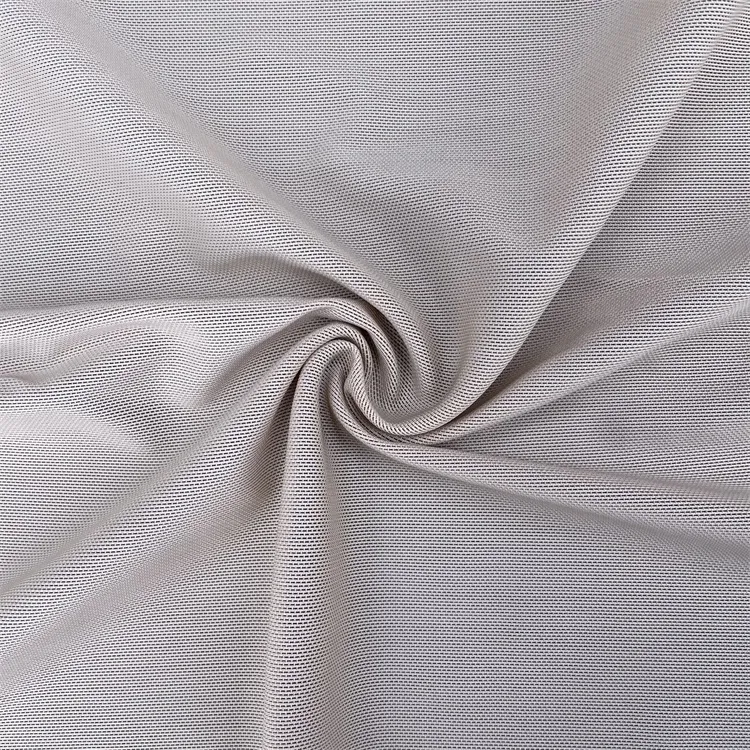
Power mesh fabric provides controlled stretch and support without the stiffness of rigid fabrics. For shapewear, corsets, and lingerie wings, buyers must evaluate the compression level, stretch recovery, GSM, and skin comfort before bulk approval.
Do not judge power mesh as an ordinary decorative fabric. A swatch that feels soft on a table may fail to hold the body in a shaping panel. Match the fabric's modulus of elasticity to the specific garment zone.
What are the main power mesh use cases?
Support requirements change drastically across different garment zones. Buyers should classify their power mesh needs into four technical use cases before sampling:
- Light support panels: Require gentle rebound and soft skin contact without harsh pressure.
- Bra wings and side panels: Demand controlled recovery, opacity under tension, and superior edge comfort.
- Shapewear zones: Require firm compression (15% to 25% spandex), high modulus, and strict dimensional stability.
- Reinforcement linings: Need structural support while remaining invisible and comfortable against the skin.
How to test power mesh elasticity and recovery?
In high-pressure shapewear, the key mechanical property is the fabric’s modulus of elasticity (the force required to stretch the fabric). Bulk production sampling should rely on quantitative elasticity thresholds to prevent garment deformation.
- Elongation Test (ASTM D4964): Under constant-rate-of-extension tension tests, unrecovered stretch must remain strictly < 5% after repeated 30% extension cycles.
- Elasticity Recovery (ISO 20932): Fabric must demonstrate >= 95% recovery warp-wise after washing.
How to prevent seam distortion and degradation?
Shapewear undergoes harsh conditions like sweat acidity and body oils, which degrade spandex fibers. Moreover, the high tension of shaping garments places massive stress on seams.
- Seam Slippage (ASTM D1683): A minimum seam strength of 150 N is required so open-loop meshes do not rupture at stitch lines.
- Chlorine Resistance (ISO 105-E03): Colorfastness and elasticity retention must be verified against chlorinated water to prevent spandex degradation.
- Skin Safety: Products must meet OEKO-TEX STANDARD 100 Class II for direct-to-skin contact, ensuring zero formaldehyde.
What should go into the power mesh RFQ?
If you are ready to request pricing, specify the garment zone, the measurable elasticity target, and compliance requirements (e.g., FTC textile labeling rules). This prevents suppliers from quoting generic decorative mesh.
Include these details in your RFQ:
- Panel Name: Bra wing, waist shaper, or side panel.
- Support Target: Light, medium, or firm control.
- GSM and Width: Specific weight range and cuttable width.
- Stretch Direction: Two-way or four-way stretch expectations.
- Quality Standards: Required ASTM or ISO test thresholds for recovery and seam strength.
By fixing these variables, bulk approval goes faster. Submit your technical specifications through our fabric inquiry form to receive targeted power mesh samples.
Related component checks include bra lining and underwear panels and swimwear lining options. Product teams can also browse our technical materials in our underwear fabric and mesh fabric catalogs.
For a broader benchmark, Intertek's High-Performance Mark durable textile and apparel standard treats stretch and recovery, pilling, bursting strength, seam performance and color fastness as connected durability checks. Teams should therefore approve support level, recovery and seam behavior together, especially for shapewear panels held under constant body tension.
Continue your fabric sourcing review
Compare the related category and product examples, then send your target composition, GSM, width, end use, quantity or sample reference for a factory review.