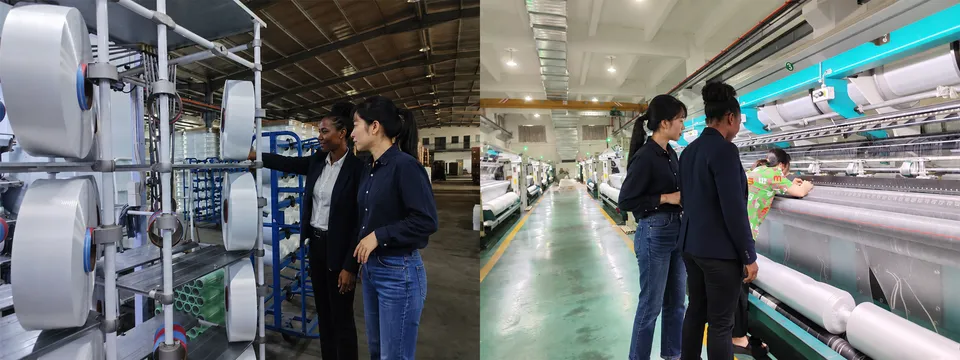
A customer or third-party factory visit is one of the clearest ways to verify production capability, quality-control discipline, and technical alignment. A fabric sample can show handfeel, weight, and surface appearance, but it cannot prove whether the mill can repeat the same result in bulk.
In this visit, the warp-knitting review focused on four technical areas: warping creel tension, Karl Mayer machine settings, grey fabric inspection, and dyehouse stenter control. These checkpoints help confirm whether bulk production can match the approved pre-production sample.
Warp knitted fabrics such as tricot mesh, power net, and high-stretch sportswear materials depend on precise mechanical settings. Unlike circular knitting, warp knitting feeds thousands of yarn ends from beams at the same time.
If one yarn has incorrect tension, or if a guide bar is misaligned by a fraction of a millimeter, the defect can run through the entire roll as vertical or horizontal barre. That is why the visit included machine-floor checks and inspection records, not only meeting-room introductions.
What the Visit Reviewed in Yarn Warping
The warping department is the foundation of warp knitting quality. Here, yarns are drawn from hundreds of yarn packages arranged on a creel and wound parallel onto a warp beam. During the visit, three warping controls were reviewed first:
Textile World's knit structures overview is a useful external reference because it separates warp knitting from weft knitting by yarn movement and machine formation. During a factory visit, that context explains why beam tension and guide-bar setup deserve direct inspection.
- Tension Control Systems: The creel must be equipped with individual tension discs or electromagnetic tension controllers for each yarn end. The visiting team should verify that the factory conducts regular tension audits across the creel (using a tension meter) to ensure the variance between yarn ends is within ± 1.0 gram. Tension variations during warping will cause uneven take-up on the beam, leading to wavy fabric structure and uneven stretch recovery in the finished garment.
- Static Electricity Elimination: Synthetic filaments like nylon and polyester generate high static charges at high speeds. The warping machine must have active ionizer bars to neutralize static. Without static control, fibers will repel each other, causing yarn entanglement, filament breakage, and micro-loops on the beam surface.
- Environmental Control: The warping room must maintain constant temperature (22°C ± 2°C) and relative humidity (65% ± 5%). This stabilizes the physical properties of the synthetic yarns and prevents tension fluctuations. The visiting team should inspect the room’s hygrometer logs to confirm continuous compliance.
On-Site Checkpoints for Karl Mayer Warp Knitting Machines
On the knitting floor, the audit should evaluate the setup and maintenance of the warp knitting machines (such as Karl Mayer HKS tricot or raschel machines). Key technical checkpoints include:
The electronic beam let-off system (EBA/EBC) controls yarn run-in per rack, where one rack equals 480 courses. Auditors should compare the control-panel values with the approved technical specification sheet.
- Run-in ratio: confirm the front guide bar for the ground structure and the back guide bar for the spandex insert.
- Operator adjustment: check whether let-off speed was changed to increase meters per beam, which can reduce GSM and stretch recovery.
- Needle condition: inspect latch needles, compound needles, and sinkers because worn parts cause micro-holes and warp runs.
| Production Phase | On-Site Audit Checkpoint | Critical Parameters | Defects Avoided |
|---|---|---|---|
| Yarn Warping | Creel tension uniformity & static ionizer bars | Tension variance ≤ ± 1.0g; RH 60% – 70% | Horizontal barre lines, yarn entanglement, broken filaments |
| Warp Knitting | Karl Mayer HKS machine let-off EBA/EBC calibration | Yarn run-in per rack within ± 2.0% of spec | Weight variations, elastic growth, structural distortion |
| Grey Fabric QA | On-frame inspection immediately after knitting | ASTM D5430 4-Point grading system | Bulk dye defect propagation, needle lines, oil stains |
| Dyehouse Finishing | Stenter frame heat-setting and relaxation | Temp 185°C – 195°C; dwell time 30 – 45s | High wash shrinkage, width curling, spandex degradation |
Grey Fabric Inspection and Defect Flagging
A reliable warp-knitting mill should inspect grey fabric before dyeing. After knitting, each roll should be mounted on a backlit inspection frame so needle lines, grease spots, broken warps, and barre can be flagged early.
- Grading method: verify that inspectors use the ASTM D5430 Four-Point System.
- Defect marking: confirm that defects are marked with plastic tags on the selvage.
- Rejection rule: reject rolls that exceed the agreed point threshold, often 40 points per 100 square yards.
- Business reason: early rejection avoids dyeing waste and reduces dispute delays after finishing.
Questions the Visit Helped Answer
What is the difference between Tricot and Raschel warp knitting machines in practical fabric development?
Tricot and Raschel machines differ in needle type, sinker configuration, and patterning capability. Tricot machines typically use compound needles, fine gauges such as E28 to E36, and high-speed operation up to about 2,000 RPM.
In practical development, tricot is usually the better fit for fine, smooth, lightweight fabrics such as tricot mesh, swimsuit shell fabric, and lingerie lining. Raschel machines use latch or compound needles with wider guide-bar movement, making them better for power net, lace, cargo netting, and other open structures.
Why does the warping and knitting floor require strict temperature and relative humidity controls?
Polyester and nylon yarns are viscoelastic materials; their tensile strength, elasticity, and friction coefficients vary with environmental temperature and humidity. Low humidity increases static electricity, causing yarn filaments to fray, split, and snag on the machine guides, resulting in micro-holes in the fabric. High humidity causes nylon fibers to swell, changing the yarn tension. By maintaining a constant 22°C and 65% RH, the mill ensures that the yarn tension remains stable from the beginning to the end of the beam, preventing roll-to-roll weight variations and horizontal shading (barre).
How can a visiting team review raw-material and batch traceability?
During the visit, a useful check is a traceback test. Select a finished fabric roll at random from the warehouse and ask the QC manager to trace it backward using the roll ID.
- Finishing proof: stenter log with temperature and speed.
- Dyehouse proof: batch card with dyes, lot pH, and temperature curve.
- Grey fabric proof: inspection record with defect points.
- Knitting proof: machine ID, operator, beam ID, yarn lot, and incoming-material certificate.
If the factory cannot link a finished roll back to its yarn lot within 30 minutes, the traceability system is weak and bulk-order risk is high.
For technical comparison, review our products range, factory background, and submit specifications via the fabric inquiry form. Teams can also review our guide to warp knitting factory checks before bulk fabric orders.
International teams can compare factory information with recognized testing and conformity-assessment language. The ISO textiles sector overview places textile testing, inspection, and product certification in the same supply-chain context.
For cross-border textile programs, the WTO Technical Barriers to Trade overview explains why standards and conformity assessment matter in international trade. Factory defect inspections should follow ASTM D5430 guidelines, and washing shrinkage should be tested under ISO 6330 wash procedures.
Review company background, production capability and inquiry options
COMPANY TRUST HUB
Continue your fabric sourcing review
Compare the related category and product examples, then send your target composition, GSM, width, end use, quantity or sample reference for a factory review.