
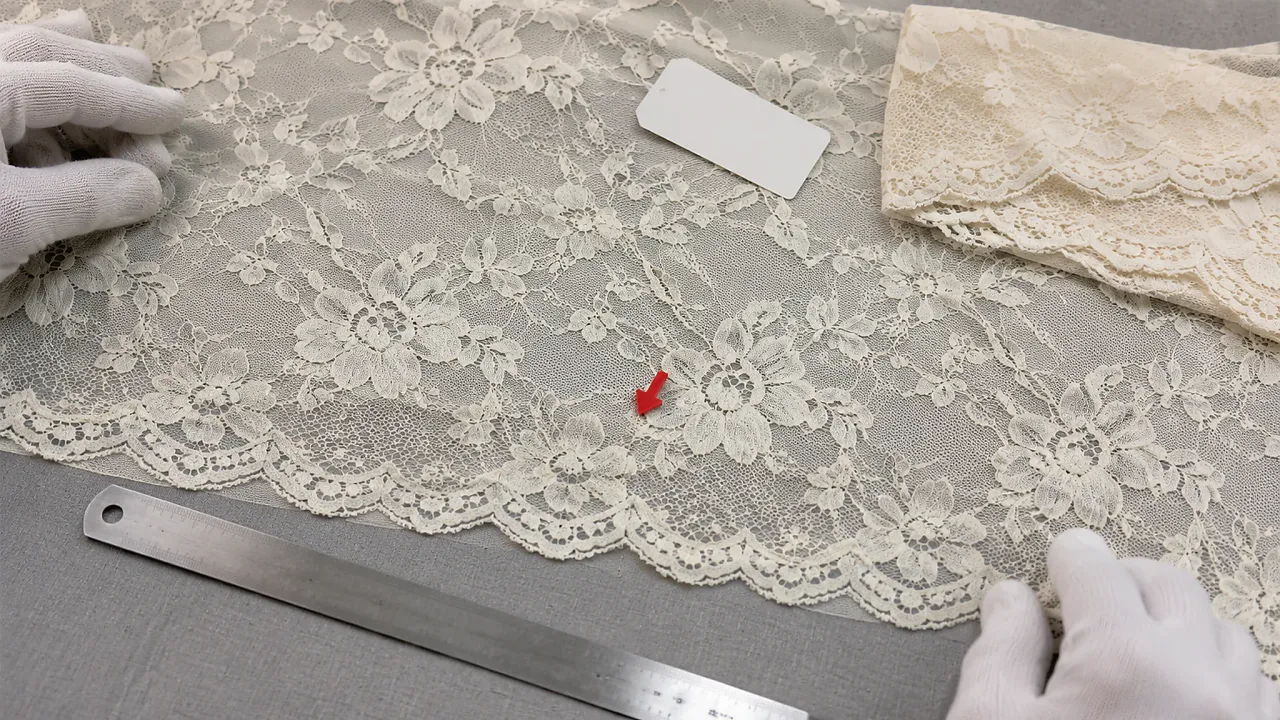
A lace fabric shrinkage test is useful only when the starting sample, measurement state, process and acceptance basis are traceable. A result such as "passed" or "2% shrinkage" does not tell a lingerie factory whether the motif still centres on a cup panel, whether a scalloped edge still follows the paper pattern, or whether the lace puckers after it is joined to lining. The release decision therefore belongs to the complete panel approval record, not to one percentage in isolation.
This guide describes a buyer-facing test and approval workflow for custom lace development. It does not set a universal tolerance, sample size, relaxation time, wash cycle or pressing recipe. Those fields must come from the intended garment, care route, buyer specification and agreed test method.
What counts as shrinkage in lace fabric?
Garment teams often use the word shrinkage for several different changes. Separating the conditions prevents a roll-tension release or sewing distortion from being reported as wash shrinkage. It also shows which stage needs a material, finishing or construction decision.
| Condition | What may change | What the result helps explain |
|---|---|---|
| Roll relaxation | Released length or width, edge waviness and surface state | The response after roll or packaging tension is removed |
| Agreed washing and drying | Measured lengthwise and widthwise dimensional change plus appearance | The result under the selected care-test procedure |
| Steam or pressing simulation | Tightening, curling, surface change or motif movement | Compatibility with a planned garment-finishing process |
| Mock sewing with lining | Puckering, growth, edge wave and motif displacement | Whether the material combination and construction behave together |
Steam and mock-seam checks are development simulations when they match the proposed garment process. Their observations should remain separate from the washing-and-drying dimensional-change result. This distinction keeps the report useful when the buyer, fabric mill and garment factory investigate different stages.
Define the lace test plan before measuring
Start by identifying whether the material is a full-width fabric or a narrow trim and whether it is stretch or stable lace. The stretch lace versus rigid lace guide explains the selection questions; this page begins after the construction and panel role have been selected for testing.
- Identify the garment and panel: cup overlay, wing, body panel, neckline, hem, trim or another use.
- State whether the sample is full-width lace, narrow trim, stretch lace or stable lace.
- Record the intended lining, elastic, seam type and handling route when they affect the panel.
- Define the care, drying, steaming and pressing processes that the garment is expected to encounter.
- Agree the specimen state, measurement directions, test method, reporting fields and decision owner.
- Identify the approved physical sample, artwork, colour, finish and development version used as the comparison basis.
The plan should also state what happens if the lace dimensions meet the agreed limit but a placement-critical motif or scallop no longer aligns with the approved panel. That is a garment-use decision, so the responsible buyer and garment factory need to define it before bulk fabric is cut.
Prepare, relax and mark the lace sample
ISO 3759:2011 specifies procedures for preparing, marking and measuring textile fabrics and garments in tests for dimensional change. Use the edition and procedure required by the buyer or laboratory. The standard scope supports a controlled measurement process; it does not create one universal lace sample size or relaxation time for every programme.
- Record the sample ID, version or lot, composition if known, construction, colour, finish and test purpose.
- Bring the sample to the measurement state defined in the agreed method without forcing wavy edges or scallops flat.
- Mark lengthwise and widthwise reference points in the locations and format defined by the method.
- Mark relevant motif repeats, motif centres, scallop depth, decorative edges and the proposed panel area.
- Measure and photograph the starting state with direction labels and a visible scale reference.
- Keep the original readings, image names, operator, date and method reference in the test record.
For stretch lace, a relaxed measurement and an intentionally extended appearance check answer different questions. Use the defined state for the dimensional-change calculation. If the programme also needs a visual check under extension, label it separately and record the applied condition so another reviewer can reproduce the comparison.
Run the agreed washing and drying dimensional-change test
The three standards have different roles. ISO 3759:2011 covers preparation, marking and measuring. ISO 6330:2021 specifies domestic washing and drying procedures for textile testing. ISO 5077:2007 specifies determination of dimensional change after washing and drying. The buyer, laboratory and suppliers still need to identify the selected procedure and acceptance requirement for the actual garment programme.
| Record field | What the report should identify | Why it matters |
|---|---|---|
| Specimen identity | Sample version, direction, colour, finish and relevant lot | Prevents an earlier development sample from being mistaken for bulk material |
| Procedure | Preparation, wash and drying procedure, cycles and measurement state named in the project | Makes the result interpretable and repeatable |
| Dimensions | Initial and final values in each measured direction plus the project-specified result | Shows which direction changed and preserves the source measurements |
| Visual observations | Motif, scallop, edge, surface, colour and distortion observations | Captures panel-relevant changes that one outer measurement may miss |
| Decision | Requirement, comparison reference, approver and released scope | Connects the test result with sample or bulk-cutting approval |
Report the lengthwise and widthwise results using the calculation and rounding rule named in the project method. Do not transfer a value from a different washing procedure, drying route, specimen state or lace construction and present it as comparable. Retain the before-and-after values so a reviewer can distinguish the measured change from a transcription or calculation error.
Check motif, scallop and usable panel position
A lace sample can show limited change across its outer dimensions while a placement-critical feature still moves enough to affect cutting. Recheck the same marked motif centres, repeat spacing, scallop points and usable boundaries after the agreed process. The lace consumption guide covers marker and usable-area planning; this test determines whether the approved geometry remains a reliable planning reference.
| Lace-specific check | Approval question | Possible production effect |
|---|---|---|
| Motif repeat and centre | Does the feature remain in the approved location and direction? | Cup, neckline or mirrored-panel placement can shift |
| Scallop spacing and depth | Does the decorative edge still follow the intended paper-pattern line? | Paired edges or continuous trims may not align |
| Usable patterned area | Does the available area still support the approved marker? | Panel yield and cutting position may change |
| Edge and surface state | Are waviness, curl or local distortion acceptable for the panel? | Spreading, cutting and sewing can become less consistent |
| Defined stretch state | Is the relaxed result separate from any agreed extended visual check? | Coverage and motif appearance can be misinterpreted |
Photograph the same marked areas before and after testing using the same face, direction and scale reference. A close-up without the complete panel context may show texture change but cannot prove whether a motif moved relative to the cutting line.
Add steam, pressing and lining mock-up checks when relevant
Run a steam or pressing simulation only when the proposed garment process includes that exposure, and use the conditions approved for development. Record tightening, curling, gloss or surface change, motif movement and edge behaviour as a separate process result. Do not merge that observation into the wash-and-dry dimensional-change result.
For placement-critical lingerie panels, make a small mock-up with the intended lining, seam type, elastic or binding and normal handling direction. Compare the panel after sewing and after any relevant finishing step. Look for seam puckering, edge wave, growth, left-right imbalance and displacement of the feature that the pattern is meant to display. The result supports development approval; it does not replace the agreed textile laboratory test.
- Use the lining and supporting materials planned for the garment sample.
- Identify seam type, direction, panel shape and handling conditions.
- Mark matching points before sewing so movement can be compared after assembly.
- Record whether the issue appears in the lace, lining, seam or combination rather than assigning an unverified cause.
- Keep wash, steam and mock-seam decisions in separate report fields.
Build a traceable lace approval record
| Stage | Record | Release question |
|---|---|---|
| Before testing | Sample version, direction, starting dimensions, motif and scallop marks | Is the starting sample correctly identified and reproducible? |
| After relaxation | Dimensions, rest condition, edge and surface observations | Is the release from roll or packaging tension acceptable? |
| After washing and drying | Procedure, directional results, motif, scallop and visual observations | Does the sample meet the agreed method and garment-use requirement? |
| After steam or pressing | Separate process conditions and appearance or dimensional observations | Is the material compatible with the proposed finishing route? |
| After mock sewing | Lining, seam, panel direction, puckering, wave, growth and placement | Can the combination proceed to garment sample or bulk approval? |
State exactly what is being released: one development sample, one colour, one finish, one lot, or the defined bulk scope. If the lace construction, colour treatment, finish, lining or garment process changes, review whether the earlier result still represents the new combination instead of carrying approval forward automatically.
Avoid common lace shrinkage approval mistakes
- Writing only "shrinkage passed" without the method, direction, procedure or sample version.
- Treating change after roll relaxation as if it were change after washing and drying.
- Measuring only the outer rectangle and ignoring motif centre, scallop spacing and usable panel position.
- Testing an isolated swatch while ignoring the lining, seam or finishing process used in the garment.
- Using a hand-stretch impression as a substitute for defined measurements and states.
- Reusing an earlier result after construction, finish, colour treatment or garment process has changed.
- Copying one programme's tolerance into every lace RFQ without technical agreement.
- Releasing bulk cutting without naming the approver and the exact material scope covered by the decision.
Use the lace defect inspection guide for incoming holes, motif distortion, shade variation and roll-level release questions. Dimensional-change testing and incoming defect inspection can share sample identity and photographs, but they should not collapse into one undocumented pass-fail field.
What to send in a custom lace testing RFQ
A useful inquiry separates fixed buyer requirements from fields that remain open for supplier recommendation and sampling. The fabric RFQ preparation guide provides the broader specification workflow; add the lace-specific testing fields below for this development task.
- Garment type, panel role and target market.
- Full-width lace or trim, stretch direction, stable or elastic behaviour, and known composition.
- Reference sample, artwork, approved motif, scallop or placement-critical feature.
- Lining, elastic, seam and panel-construction plan.
- Care-label route and planned washing, drying, steaming or pressing process.
- Required test method, procedure, directions, reporting rule and acceptance owner.
- Sample quantity, colour, finish, required comparison version and approval deadline.
- Fields already fixed by the buyer and fields open for development recommendation.
Submit these details through the fabric inquiry form. Changle Textile can use the intended panel, lining plan, care route and reference sample to discuss a suitable development and approval path without treating a catalogue specification as a universal bulk guarantee.
Lace fabric shrinkage test questions
Q1. Does all lace fabric shrink?
Do not assume that every lace changes in the same way or by the same amount. Construction, yarns, finish, sample state and the applied process all affect the result. Test the actual development or bulk reference under the agreed conditions and approve it for the intended garment use.
Q2. Is polyester lace dimensionally stable without testing?
Fibre name alone does not establish dimensional stability for a finished lace construction. The buyer still needs evidence for the actual structure, finish, care route and panel combination. Use the agreed dimensional-change test rather than approving polyester lace from composition alone.
Q3. Should stretch lace be measured relaxed or extended?
Use the specimen state defined in the agreed dimensional-change method. A relaxed dimensional measurement and an extended visual or fit check answer different questions. If both are needed, state the condition for each and report them separately.
Q4. Can a steam test replace a wash-and-dry test?
No. A steam or pressing simulation checks response to a garment-finishing process. A wash-and-dry test checks dimensional change under the selected laundering procedure. Run and record the relevant processes separately.
Q5. What is an acceptable lace shrinkage percentage?
There is no single percentage in this guide for every lace and garment. The buyer and suppliers should agree the method and acceptance requirement using garment use, panel geometry, care route and physical sample approval. A dimensional value may still need review if motif or scallop placement becomes unsuitable.
Q6. Why can lace pass a flat test but pucker after sewing to lining?
The flat lace result does not measure every interaction with lining, seam formation, elastic, handling and panel shape. A mock panel can reveal mismatch or distortion in the assembled combination. Record that outcome separately and let the responsible development team confirm the cause and corrective action.
Related lace and fabric approval guides
Continue with the general fabric shrinkage guide for broad causes and manufacturing controls, stretch lace versus rigid lace for material selection, lace defects before cutting for incoming inspection, lace consumption for lingerie panels for marker planning, and the fabric RFQ guide for supplier communication. Together, these pages keep material choice, testing, incoming release and cutting planning as distinct decisions.
Continue your fabric sourcing review
Compare the related category and product examples, then send your target composition, GSM, width, end use, quantity or sample reference for a factory review.