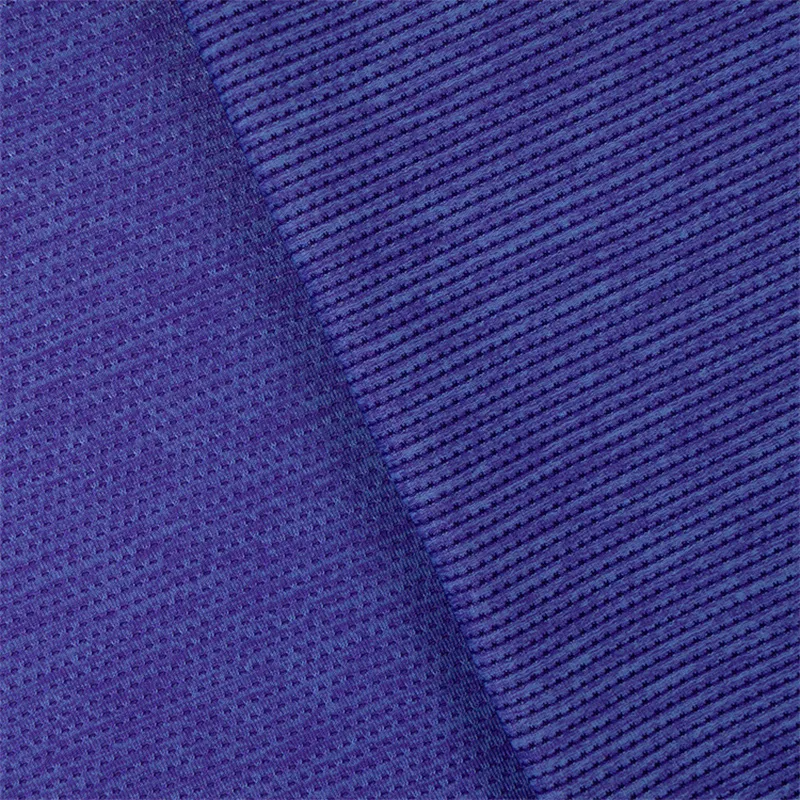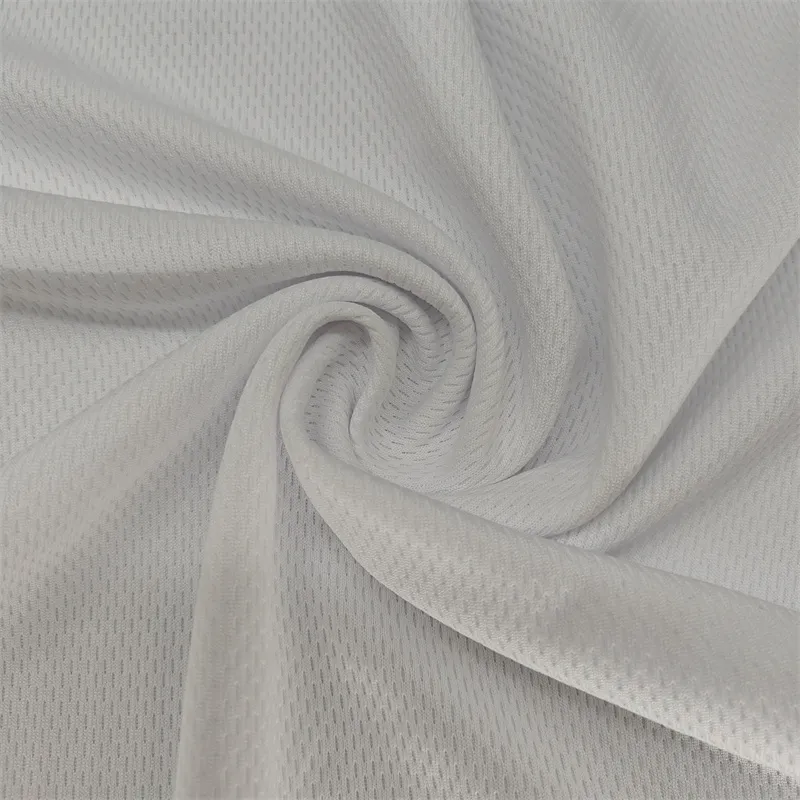
Do not decide only by which fabric “feels lighter.” On published grades on this site, micro mesh runs about 65–185 GSM and bird eye examples run about 155–300 GSM. The bands overlap around 150–185 GSM, so a midweight sports shirt can still be classic micro mesh while a 155–160 GSM training top can still be bird eye. Lock garment role and hole pattern before bulk.
This page is only for structure and role selection between micro mesh and bird eye mesh. After fiber is fixed, use the polyester mesh vs nylon mesh guide. After bird eye is selected and you need structure and GSM detail, use the bird eye mesh structure and GSM guide. If the open question is pin-dot versus bird eye as body fabric, use the pin-dot mesh vs bird eye mesh guide.
What micro mesh means in a sportswear RFQ
Micro mesh is a fine open knit with small, evenly spaced holes. On this site it appears as tricot or warp-knit micro mesh for light jerseys and linings, classic micro mesh for sports shirts, and polyester/spandex stretch micro mesh for fitted panels. The shared clue is a finer opening scale than a coarse sports-mesh face, not a claim that every micro mesh grade is only a lining.
Published grades show three useful paths. FTT10033 is a 65 GSM, 100% polyester tricot micro mesh listed for basketball, soccer and lacrosse jerseys as well as sportswear lining, with see-through called out on the product unit. HS2039 is a 70 GSM warp-knit micro mesh aimed at sportswear mesh linings and other low-bulk layers. HS147 is a 150 GSM classic micro mesh for sports shirts, so midweight micro can still be a face fabric when the hole pattern is approved.
- Lining / pocket / fine underlayer path: start with light warp-knit micro mesh when bulk and skin contact matter more than a heavy sports-mesh look.
- Light or midweight face path: jersey or sports-shirt micro mesh is possible, but 65–110 GSM see-through grades need opacity checks before they are locked as a full body shell.
- Stretch path: if the panel needs recovery, name polyester/spandex micro mesh. Do not assume a 100% polyester bird eye body fabric will replace a fitted stretch insert.
Bird eye, only as the comparison anchor
Bird eye mesh is the more textured sports-mesh face many training tops and team shirts use as the main shell. For this comparison, treat it as the option with a clearer bird-eye surface rather than a fine lining-scale hole pattern. Published examples on this site include about 155 GSM, 230 GSM and 300 GSM grades. Parameter detail after bird eye is selected belongs in the bird eye mesh structure and GSM guide, not in a second encyclopedia section here.
What to compare before you sample
Use the fields that change the sample path. Exact hole size, opacity, print clarity and recovery still need yardage confirmation.
| Decision field | Micro mesh is usually the better first shortlist when... | Bird eye is usually the better first shortlist when... |
|---|---|---|
| Garment role | Lining, pocketing, fine underlayer, light jersey face or stretch insert. | Main body of training tops, team shirts and structured sports shells. |
| Surface look | Finer, more even micro-openings with a weaker sports-mesh texture. | Clearer bird-eye texture that reads as classic team sports mesh. |
| GSM band on published grades | About 65–185 GSM across light lining to stretch micro mesh grades. | About 155–300 GSM across published bird eye examples on this site. |
| Overlap band | Around 150–185 GSM a classic or stretch micro mesh can still be a shirt face or fitted panel. | Around 155–160 GSM bird eye can still be a body fabric. Name the structure; do not send only a GSM number. |
| Opacity risk | 65–110 GSM see-through grades need coverage checks before they are locked as a full shell. | Midweight-to-heavy bird eye usually starts with more body coverage for full garments, but still needs a hand sample. |
| Stretch path | Clear polyester/spandex micro mesh path for fitted tops and recovery panels. | Many programs start with 100% polyester bird eye body fabric. Do not invent stretch performance without naming elastane. |
| Print / team colour work | Fine holes can still accept print, but edge sharpness and colour depth must be checked on the real hole pattern. | Common shell path for team colour or sublimation programs after structure and GSM are locked first. |
Published micro mesh grades on this site
These six SKUs are the evidence base for micro mesh claims on this page. Use them as shortlist anchors, not as a claim that every mill’s micro mesh matches the same GSM.
| Item | GSM | Structure notes from the product unit | Published uses |
|---|---|---|---|
| FTT10033 | 65 | Tricot mesh; 100% polyester; product unit notes see-through | Basketball, soccer and lacrosse jerseys; sportswear lining |
| HS2039 | 70 | Warp-knit micro mesh; 100% polyester | Sportswear mesh linings, gym wear, sports bras |
| HS068 | 110 | Warp knit micro mesh; product unit notes see-through | Sports jerseys, athletic uniforms, lining, mesh pocketing |
| HS147 | 150 | Classic micro mesh; 100% polyester | Sports shirts, T-shirts, kids wear |
| HS5952 | 185 | Stretch micro mesh jersey; 90% polyester / 10% spandex | Fitted activewear tops, stretch panels, training shirts |
| HS5953 | 185 | Stretch micro mesh; 92% polyester / 8% spandex; tighter surface than open football mesh in product copy | Performance tops, outdoor activewear, stretch sportswear |
Bird eye remains available as a parallel body-fabric family on this site. Use the bird eye mesh structure and GSM guide or published grades such as FTT10272, Co03 and HS051 after the structure choice is fixed. Do not treat the micro mesh table above as a substitute for bird eye parameter selection.
First structure to sample by program
| Program | First shortlist | Why | Main wrong-path risk |
|---|---|---|---|
| Team jersey or training top main body with sports-mesh look | Bird eye mesh | Body role and bird-eye surface are the primary signals | Lining-weight micro mesh may look too fine or sheer as a full shell |
| Lining, pocket bag or sports-bra mesh layer | Micro mesh such as HS2039-class lining grades | Low bulk and fine openings match underlayer roles | Heavy bird eye adds bulk, stiffness and the wrong surface role |
| Light jersey face that can accept openness if opacity is checked | Light micro mesh such as FTT10033 or HS068 | Published grades already list jersey or uniform use with fine openings | Skipping opacity and print checks after approving only by GSM |
| Midweight sports shirt that wants micro holes, not bird-eye texture | Classic micro mesh such as HS147 | 150 GSM sits in the overlap band but still uses a micro face path | RFQ written only as 150–160 GSM may pull a bird eye body sample instead |
| Fitted panel that needs stretch recovery on a fine open knit | Stretch micro mesh such as HS5952 or HS5953 | Published polyester/spandex micro grades exist for this path | Sampling non-elastane bird eye body fabric for a recovery panel |
| Body fabric shortlist between regular pin holes and bird-eye texture | Leave this page; use the pin-dot vs bird eye guide | That decision is a body-fabric surface choice, not lining vs bird eye | Forcing pin-dot into a micro mesh RFQ confuses three structure families |
Where pin-dot mesh fits
Pin-dot mesh is not a synonym for micro mesh or bird eye. If the program already needs an open sports-mesh body and the real choice is regular pin holes versus bird-eye texture, use the pin-dot mesh vs bird eye mesh guide. Do not expand pin-dot sampling on this page.
Common sampling mistakes that waste a round
- The RFQ only says mesh fabric, so the mill samples lining micro mesh and a bird eye shell for the same panel brief.
- 65–70 GSM micro mesh is requested as a heavy training-shirt body, then rejected for sheer coverage or weak graphic definition.
- 230–300 GSM bird eye is requested as a lining or pocket bag, then rejected for bulk, stiffness or cost.
- Only a midweight GSM such as 160 is written, with no structure name, so classic micro shirt face and bird eye body samples collide.
- Stretch need is left unstated, so a non-elastane body fabric is sampled for a fitted recovery panel.
- Pin-dot, micro mesh and bird eye are used as synonyms, so hole size and surface texture never match the approved look.
Minimum RFQ fields before the first sample
- Garment role: body shell, lining, pocket, side panel or stretch insert.
- Structure family: micro mesh or bird eye mesh. Do not stop at “mesh fabric.”
- Composition and GSM range, including whether spandex recovery is required.
- Width, colour, finishing and print method.
- Reference hand sample or close-up photo of hole size and surface texture under consistent lighting.
- Estimated bulk quantity before final pricing.
If the inquiry still only says “need mesh fabric,” the mill cannot choose between lining micro mesh and a bird eye shell. Use the fabric RFQ checklist to close the open fields before sample development.
Checks after the first yardage arrives
- Opacity: hold the fabric over skin or the intended underlayer and check coverage in the actual garment zone.
- Hole match: compare hole size, spacing and surface texture against the reference photo or hand sample under the same lighting.
- Print trial: if the program is printed or sublimated, test edge sharpness and colour depth on the chosen mesh, not only on solid jersey.
- Recovery check: if stretch micro mesh is specified, confirm extension and return on the fitted panel after handling and a wash trial when required.
FAQ
Q1. What is the difference between micro mesh and bird eye mesh?
Micro mesh usually means finer, more even openings and is often shortlisted for linings, pocketing, light faces or stretch panels. Bird eye mesh usually means a clearer sports-mesh texture used as the main body of training tops and teamwear. Role and hole pattern matter more than the marketing name.
Q2. Can micro mesh be used as a sportswear body fabric?
Yes when the candidate grade supports that role. HS147 is published for sports shirts at 150 GSM. Light see-through grades such as 65–110 GSM can appear on jersey programs, but opacity and print clarity must be checked before they are locked as a full shell.
Q3. Is bird eye mesh the same as honeycomb mesh?
Some markets use honeycomb as a marketing nickname for bird-eye style openings. Treat related appearance names as clues only. The RFQ still has to lock structure, GSM, composition and a sample.
Q4. Can I choose between micro mesh and bird eye by GSM alone?
No. Published micro mesh grades on this site span about 65–185 GSM, and published bird eye examples span about 155–300 GSM. The bands overlap around 150–185 GSM, so garment role and hole pattern still have to be named.
Q5. What should I send before asking for a mesh fabric price?
Send garment role, structure family, composition, GSM range, width, colour, finishing, print method, stretch need if any, a reference photo or sample, and estimated order quantity.
If the structure choice is already clear, open the relevant product family under mesh fabric or sportswear fabric. If both micro mesh and bird eye remain possible, send the garment zone, target GSM and a surface-reference photo through the contact form so sampling starts on one structure, not two.
Related reading
Continue with the bird eye mesh structure and GSM guide after bird eye is selected, the pin-dot mesh vs bird eye mesh guide for body-fabric pin-hole choices, and the polyester mesh vs nylon mesh guide when fiber is still open. For team-program roles or print method, see fabric for team jerseys and training tops and sublimation printing on polyester knit.
Continue your fabric sourcing review
Compare the related category and product examples, then send your target composition, GSM, width, end use, quantity or sample reference for a factory review.