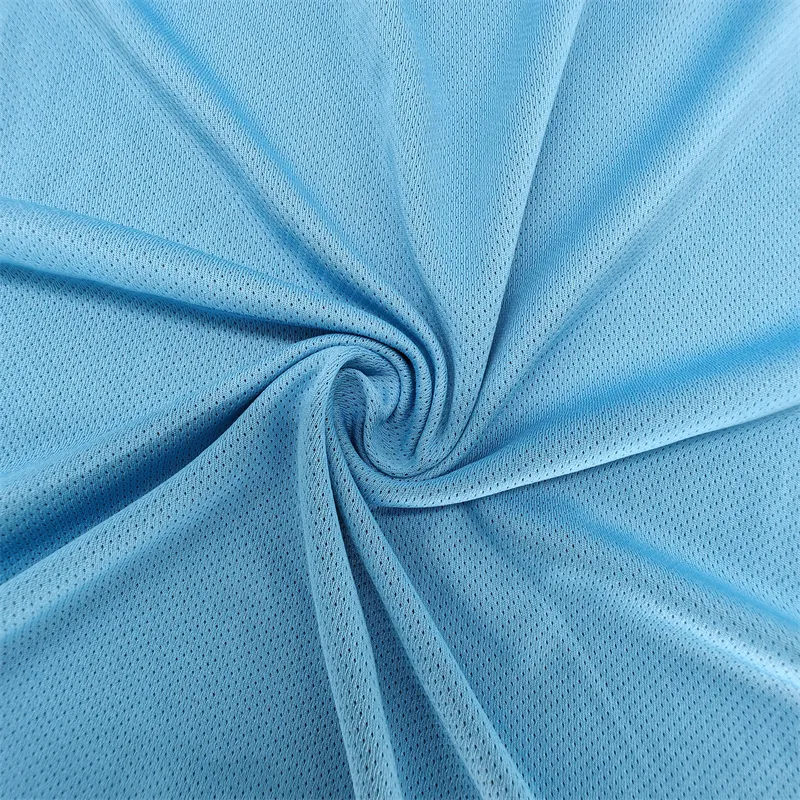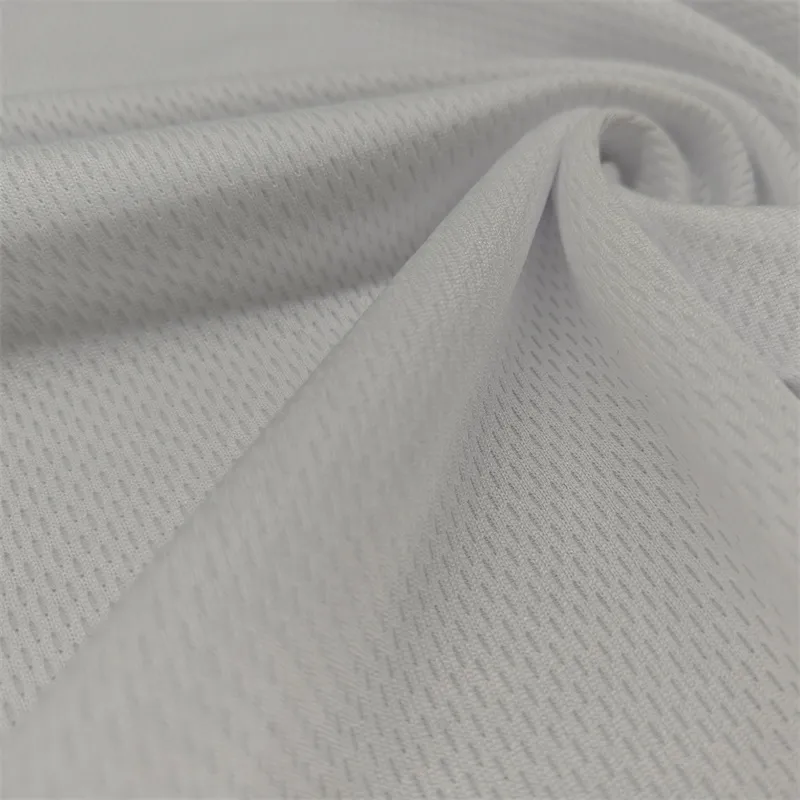
Do not decide only by which fabric “feels lighter.” On published grades on this site, pin-dot mesh runs about 145–270 GSM and bird eye examples run about 155–300 GSM. The ranges overlap, so GSM alone cannot prove the right structure. Lock surface look, garment role and a hand sample before bulk.
This page is only for body-fabric selection between pin-dot and bird eye. If the open question is lining or fine underlayers versus a bird eye shell, use the micro mesh vs bird eye mesh guide. If bird eye is already chosen and you need structure and GSM detail, use the bird eye mesh structure and GSM guide.
What pin-dot means in a sportswear RFQ
Pin-dot mesh is an open knit with small, evenly spaced holes. On sportswear programs it often sits on a double-knit or interlock base. Some inquiries also use names such as pin-dot hole mesh, flat back mesh, dimple mesh or active cloth pin-dot mesh. Those names can describe a related face, but they are not a complete specification by themselves.
Two published examples show why the alias must be locked with construction detail. FTT-WB379 is a 145 GSM, 100% polyester interlock pin-dot grade. The product copy states it is a double-knit interlock with a pin-dot face and a flatter back, and that mills may also call it flat back mesh or dimple mesh. SU01 is a 175 GSM pin-dot hole mesh with a flat back and pin-dot face for sportswear tops, training jerseys and, on that SKU only, lightweight lining use.
- Write the structure family as pin-dot mesh, not only “mesh” or “sports mesh.”
- If the buyer says flat back, dimple or active cloth pin-dot, treat that as an appearance clue and still confirm the hand sample.
- Do not assume every pin-dot SKU is lining-weight because one grade lists lightweight lining as a use.
Bird eye, only as the comparison anchor
Bird eye mesh is the more textured sports-mesh face many team shirts default to. For this comparison, treat it as the option with a clearer bird-eye surface rather than a flatter pin-dot hole pattern. Published bird eye examples on this site include about 155 GSM, 230 GSM and 300 GSM grades. Parameter detail after bird eye is selected belongs in the bird eye mesh structure and GSM guide, not in a second encyclopedia section here.
What to compare before you sample
Use the fields that change the sample path. Exact hole size, opacity and recovery still need yardage confirmation.
| Decision field | Pin-dot is usually the better first shortlist when... | Bird eye is usually the better first shortlist when... |
|---|---|---|
| Surface look | The approved look is small regular holes on a flatter face, including flat-back style pin-dot. | The approved look is a clearer bird-eye texture that reads as classic team sports mesh. |
| Garment role | Sports tops and training jerseys that want a pin-dot face. Light lining is possible only when the candidate SKU lists that role. | Main body of training tops and team shirts where bird-eye texture is already the brand default. |
| GSM band on published grades | About 145–270 GSM across four pin-dot SKUs on this site. | About 155–300 GSM across published bird eye examples on this site. |
| Main sampling risk | Treating flat back, dimple or active cloth pin-dot as a finished spec, or using a light pin-dot grade as a heavy shell without opacity checks. | Calling every sports mesh bird eye when the approved hand sample is clearly pin-dot. |
Published pin-dot grades on this site
These four SKUs are the evidence base for pin-dot claims on this page. Use them as shortlist anchors, not as a claim that every mill’s pin-dot matches the same GSM.
| Item | GSM | Structure notes from the product unit | Published uses |
|---|---|---|---|
| FTT-WB379 | 145 | Interlock pin-dot; double-knit; pin-dot face, flatter back; also called flat back or dimple mesh in product copy | Activewear, sportswear, sport tops |
| SU01 | 175 | Pin-dot hole double-knit mesh; flat back with pin-dot face | Sportswear tops, training jerseys, lightweight lining |
| HS2124 | 180 | Recycled pin-dot mesh; recycled-claim documentation must match the program | Sports shirts, activewear, team jerseys |
| HS2150 | 270 | Heavy double-knit interlock pin-dot; flat back with pin-dot face | Sports tops, team uniforms, structured sportswear |
Bird eye remains available as a parallel body-fabric family on this site. Use the bird eye mesh structure and GSM guide or the sportswear mesh category after the structure choice is fixed. Do not treat the pin-dot table above as a substitute for bird eye parameter selection.
First structure to sample by program
| Program | First shortlist | Why | Main wrong-path risk |
|---|---|---|---|
| Team jersey body that needs classic bird-eye texture | Bird eye mesh | Surface look is the primary brand signal | Pin-dot may look too flat against an approved bird-eye hand sample |
| Sports top that wants regular pin holes, not strong bird-eye texture | Pin-dot mesh | Matches the flatter pin-dot face and alias path used on interlock grades | RFQ written as bird eye forces the wrong sample family |
| Heavier structured shell around midweight-to-heavy handle | Heavy bird eye or heavy pin-dot such as HS2150 | GSM can land in either family; surface look still decides | Choosing only by “heavier fabric” without locking hole texture |
| Recycled sports-shirt program with pin-dot face already approved | rPET pin-dot HS2124 path | Recycled content and pin-dot structure are both on the RFQ | Asking only for “recycled mesh” without structure or claim documents |
| Lining, pocket bag or fine underlayer | Micro mesh first | That task is outside this body-fabric comparison | Forcing pin-dot or bird eye body grades into a lining role |
Sampling mistakes that waste a round on this comparison
- The RFQ only says mesh fabric or sports mesh, so the mill samples pin-dot and bird eye for the same body panel.
- Flat back, dimple, active cloth pin-dot and bird eye are used as synonyms, so surface texture never matches the approved look.
- GSM is used as the only selector even though pin-dot and bird eye ranges overlap on published grades.
- Print or sublimation method is left open until after structure approval, so edge sharpness is checked on the wrong hole pattern.
- Recycled content is requested without structure, so the mill cannot choose between rPET pin-dot and another recycled mesh family.
- SU01’s lightweight lining use is copied onto every pin-dot inquiry, including heavy shell programs that need HS2150-class body.
Minimum RFQ fields before the first sample
- Garment role: body shell, side panel, insert or lining.
- Structure family: pin-dot mesh or bird eye mesh. If an alias such as flat back or dimple is used, mark it as reference only until the sample is approved.
- Composition and GSM range.
- Width, colour, finishing and print method.
- Reference hand sample or close-up photo of hole size and surface texture under consistent lighting.
- Recycled-claim requirement and document need, if any.
- Estimated bulk quantity before final pricing.
If the inquiry still only says “need mesh fabric,” the mill cannot choose between pin-dot sports mesh and a bird eye shell. Use the fabric RFQ checklist to close the open fields before sample development.
FAQ
Q1. What is the difference between pin-dot mesh and bird eye mesh?
Pin-dot usually means small regular holes on a flatter face. Bird eye usually means a more textured bird-eye sports-mesh face. Both can be body fabrics. Choose by approved surface look and garment role, then confirm GSM and hand sample. Do not treat one name as automatically lighter or more breathable.
Q2. Are flat back mesh, dimple mesh and active cloth pin-dot the same as pin-dot?
They can be related appearance names. On FTT-WB379, product copy links interlock pin-dot with flat back mesh and dimple mesh. That still does not make the nickname a finished RFQ. Lock structure, GSM, composition and a sample.
Q3. Can I choose between pin-dot and bird eye by GSM alone?
No. Published pin-dot grades on this site span about 145–270 GSM, and published bird eye examples span about 155–300 GSM. The ranges overlap, so surface look and role still have to be named.
Q4. Can pin-dot mesh be used as lining?
Only when the candidate SKU supports that role. SU01 lists lightweight lining among its uses. Heavy interlock pin-dot such as HS2150 is published for structured sports tops and uniforms, not as a default lining fabric.
Q5. What should I send before asking for a pin-dot or bird eye price?
Send garment role, structure family, composition, GSM range, width, colour, finishing, print method, reference photo or sample, recycled-claim need if any, and estimated order quantity.
If pin-dot is already the structure family, open the relevant SKUs under mesh fabric, sportswear fabric or interlock fabric. If both pin-dot and bird eye remain possible, send the garment zone, target GSM and a surface-reference photo through the contact form so sampling starts on one structure, not two.
Related reading
For lining versus body questions, continue with micro mesh vs bird eye mesh. For team-program fabric roles, see fabric for team jerseys and training tops. When print method is part of the same program, see sublimation printing on polyester knit.
Continue your fabric sourcing review
Compare the related category and product examples, then send your target composition, GSM, width, end use, quantity or sample reference for a factory review.